Showing posts with label country living. Show all posts

Monday, November 16, 2009

Roadkill Mule Deer: $417

Out here in rural Utah there really isn't much traffic. More than five cars driving through town at the same time feels like rush hour and fender-benders are rare. There isn't a stop light for at least 50 miles. Yet, safe as this sounds for drivers on these country roads, there are still dangers lurking behind every juniper tree, potential disasters waiting in the sagebrush. Deer, elk -- even rabbits -- are hazardous highway threats and can leap out into the road at any mile marker. The damage they can cause to a vehicle -- and the person inside that vehicle -- can be monumental. Anything from a smashed grill, broken headlights, or a complete totaling are all possibilities, along with injuries to driver and passengers if the deer or elk happens to blast through the windshield.

So I was glad to receive a phone call and hear that my friends, Danny and Gretchen, were safe and sound after hitting and killing a two-point mule deer buck near the town cemetery. I was also quite excited to hear that they intended to call the game warden and take the deer home with them to butcher -- and that they needed my help to load the animal into their pick-up truck. "We'll give you some of the meat, if you're interested," Gretchen said. Hmm. Fresh venison, bones for soup, maybe some liver -- sounds good to me!

So off I went with my girlfriend at 9:30 p.m. to do a little "gathering." I can't really say that there was any hunting involved, as all we did was pick up a very dead deer. After loading it into Gretchen and Danny's truck, we agreed to meet up the next day to butcher.

On a beautiful Sunday afternoon in the front yard of a friends house, we began the fascinating process that human beings have engaged in for hundreds of thousands of years before us -- except we used modern technology to get the job done quicker. Danny tied one end of a rope to the hitch of his pick-up truck and the other end over a sturdy tree branch and around the buck's neck, almost like a noose readied for a hanging. Hopping in his truck and pulling forward, the 200+ lbs. animal magically rose into the air and was suspended at the perfect butchering height. Now that's country.

Danny then quickly and efficiently removed the hide of the deer by pulling it back and cutting the fine, sheath-like material just underneath. Once it was freed, Gretchen decided to work the hide and prepare it for tanning. Next, Danny hacksawed off the legs above the knee joints and began quartering the animal, procuring all the choice cuts: brisket, loins, backstrap, and plenty of meat for roasts. He had already thrown out the liver, heart, and other organ meats as they were all damaged and bloody. This particular buck was fairly lean, which makes sense given that it was a lower elevation-dwelling mule deer in October. Deer and elk in higher elevations would certainly be fatter this time of year as they pile on extra stores for the cold winter months.

Danny explained that much of the meat on the buck was questionable for human consumption due to the prevalence of CWD -- Chronic Wasting Disease -- in Utah deer populations. The risk of transmission of this prion disease (similar to the infamous "mad cow disease") to humans is thought to be very low, if at all. But we weren't willing to take the risk, so any meat stained with blood from the spine was discarded (CWD is a central nervous system disease). And we sure weren't about to eat deer brains either, so the head was also tossed.

In the end, after quartering and butchering the buck, we attained 70-80 lbs. of roasts, steaks, and tough meat for burger grind. My friend at the local meat locker was kind enough to blend the grind meat with some grass-fed beef fat he had on hand, which made for some amazing hamburgers. We also hacked up the bones, rich with marrow, for broth and soup.

Total processing costs: $17. Estimated damage to Danny and Gretchen's vehicle: $400.
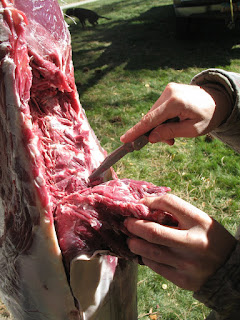
Roadkill Mule Deer: $417. A true country delicacy.
Monday, July 7, 2008

Stuck in the Sand

An essential country living skill that every small-town inhabitant around me seems to know about is the art of getting a vehicle out of the dirt. Folks around here carry boards, chains, jacks, and shovels just in case their truck or jeep gets its tires spinning in some unpaved backcountry road. It happens. Luckily, preparation for such an event can remedy the situation faster than you can say, "Garsh durnit." Without the proper tools, well, it's just a waiting game until somebody shows up who can help you.

My good friend Lyman was nice enough to give me firsthand experience in backcountry vehicle know-how. As we scouted his upcoming ATV trip in a borrowed truck, we climbed dirt roads and squirmed through sandy spots like butter. All the way, Lyman shifted in and out of 4-wheel drive, skillfully manuevering the truck as if was an extension of his body. Up to the top of the forested mountains we went, later making our way down into the desert red-rock wilderness. It was here that my education began.

Climbing a particularly steep hill in 4-wheel drive, Lyman asked me, "Are the front wheels spinning?"

I looked out the window, "Nope. Not as much as the back ones."

"Shoot," he said, "That means the 4-wheel drive is out."

"Huh?" Being a city boy, I needed more clarification.

"These automatic hubs have a tendency of going out eventually. Then the 4-wheel drive doesn't work."

"Oh," I replied, half-understandingly. "So what do we do?"

"Well, I think we can make it the rest of the way from here. Should be easy."

Famous last words.

We hit the first deep, sandy soil coming around a bend in a white-walled canyon. Some off-road motorcyclists came swerving along in the opposite direction, right by us. Their wheels made snake-like tracks in the sand, as they used their feet to keep themselves up.

"They're working hard," Lyman commented, "Glad we're in this truck."

More famous last words.

Around the next bend, we hit a wavey, rough sandy patch of road that caused the wheels to bounce: thud-thud-thud-thud-thud! Then we stopped moving. Lyman tapped the gas pedal in an attempt to crawl out of the jam to no avail. We hopped out of the truck and saw that the back tires had burrowed into the dirt.

"Shoot," Lyman said, "I forgot the shovel. We have to use our hands." He began scooping dirt from the front of the driver side rear tire. I followed his lead on the passenger rear.

Soon we had a small basin in front of each rear tire. Lyman got back in the truck and gave it gas. It scooted out of the soft depression after a few tries. Then we were on our way again.

"We're good, Ryan," Lyman says to me, "That was easy."

Once again: famous last words.

As we drove downhill from the canyon, the quality of the road changed from sandy-gravely to more of a dusty beach-like texture.

"I don't remember it being so soft on this road," Lyman thought out loud. I figured we'd be okay.

Then we hit dirt that felt like we were driving on a pile of dust. The truck swam through the road like a salmon making its way upstream in a heavy current, slowly inching its way forward. I suddenly remembered that we didn't have 4-wheel drive. The truck stopped, the wheels spun, and Lyman tapped the pedal to crawl out. Shoot. Stuck again.

We got out to assess the damage. It wasn't good. The rear tires were deep -- half-covered with dirt.

"This is bad, Ryan," Lyman says, "I don't think we're getting out of this one."

For the next couple of hours we dug out the dirt with our hands, jacked up the rear end, put sticks underneath the tires, and gave it gas. Nothing moved it. We were definitely stuck. An ant falling into an ant lion's den -- the more we tried, the deeper we got.

"I'm pretty sure I can get cell phone reception from up there," Lyman said, pointing towards some ridges off in the distance. "I'll call somebody to come help us." Off he went, while I stayed back at the truck -- just in case somebody else showed up.

I waited. And waited. And waited. No Lyman. I started to wonder if he had fallen and broke his leg. Maybe he got bit by a rattlesnake. What if he got lost? All thoughts that pass through a guy's mind while he waits for his buddy to return from the desert in the middle of nowhere.

Hours later, just as darkness was falling, Lyman showed up. "I just walked ten miles," he said, "I wish I had my heart rate monitor." Spoken like a true exercise junkie. "I got a hold of Pearl and Kendall to come pick us up. We might be waiting a while."

Soon, the troops showed up. Pearl, the rough-and-tumble hunter/fisher/dental assistant/sweetheart of a woman, and Kendall, a Wayne County local who seemed to know more than a little about getting out of a backcountry jam. They had the boards; they had the chains; they had the shovel; they had the 4-wheel drive. We were saved.

On the drive home, Lyman turns to me and says, "I think I'm going to change the ATV trip route." I couldn't agree more, buddy. I couldn't agree more.