Thursday, March 31, 2011

My Intestinal Saga, Part 6: It's All Digestive, My Dear Watson

On Kwasniewski's Optimal Diet, I felt the strongest I had felt since I was a high school athlete working out at the gym 6 days a week.  My body composition was extremely desirable to me.  I felt solid and seemed to build muscle very easily.  Eating gobs and gobs of fat along with just enough protein, I was never unsatisfied with meals.  The satiety factor of this dietary pattern was incredible, and I happily stuck to it for close to a year even though I had odd muscle tension throughout my body and would toss and turn in my sleep, sometimes waking up for three hours around 3:00 A.M.  My breath also was absolutely horrible, as my girlfriend at the time made perfectly clear to me.  There were so many things right with the Optimal Diet and, yet, so many things were wrong.  I had the body and strength that I wanted, but, good Lord, was I slothful at times.

Me on the Optimal Diet
During the Optimal Diet, I began to tweak my mealtimes to see whether or not my symptoms were fully attributed to the digestion and absorption of my food.  I experimented with one meal a day, which was easy to do and get adequate calories from since the foods I was eating were so low in fiber and very calorically dense.  As I had expected, my symptoms suddenly became isolated to certain times, depending on when I ate.

First, an hour after eating, my chest would usually begin hurting and feeling tender and then subside over another hour.  Also during this time, I would often get a headache and a bit of lower abdominal discomfort along with a unique "pins and needles" feeling in my chest/upper abdomen.  About 8-10 hours after the large meal, in addition to bloating, I'd feel heaviness come over me in the form of shoulder, abdominal, and -- oddly enough -- left calf tension.  From my studies of human digestion, I knew this is when the food would have been traveling through my small intestine (food typically empties from the stomach in 3 hours).  So I thought maybe something was wrong with that part of my GI tract, but had no clue what it could be.  Sometimes the abdominal tension (which felt like a rock) would be so bad that it would "push up" my stomach, and I'd actually have to vomit.  Taking the experiment further, I learned that if I fasted for a day, I would feel absolutely amazing the entire next day.  Upon eating again, I'd experience some "tender chest" pain, but no "pins and needles," headache or lower abdominal discomfort.  I realized after eating the next day and then feeling those symptoms coming on that they were actually happening 24 hours after my last meal.  I came to call these the "24 hour symptoms" as a result of this discovery.  The "8-10 hour symptoms" consistently happened the same time after mealtime.

So I had my answer.  My detective work paid off.  It was all digestive.  It wasn't "all in my head" as some of my close friends and family suggested.  It wasn't due to poor posture or not exercising enough.  It wasn't because I was some kind of hypochondriac.  It was because I had friggin' digestive problems.

Abdominal/Pelvic CT scan
At this point, some of you may be thinking, "Ryan, why the heck didn't you just go to a doctor to diagnose all of this?"  Well, I did.  I saw quite a few M.D.'s, Naturopaths, and body workers, and they all provided some pieces of the puzzle, but I never got a definitive answer from any of them.  I was subjected to various tests, as well -- barium swallow abdominal/pelvic CT scan, gall bladder ultrasound, and stool/blood analyses of all kinds -- and nothing informed me that I had specific digestive problems.  Yet, here I was with direct experiential proof that all of my symptoms were, in fact, digestive.    

I felt defeated, worn out -- ready to be done with these problems that plagued me over the years.  I knew I was having GI problems, and I had tried the herbs, enzymes, HCL, etc., etc., and the only thing that worked was to either eat nothing or eat less.  And to do that meant I would be back at an unhealthy weight, feeling weak and hungry.  Wonderful.  I was stuck with this sh*t.  But I wasn't ready to give up.  In fact, I was entirely prepared to do whatever it took to get well again.  Onward into the fascinating world of *drumroll* fecal bacteriotherapy.  Say what?!  Yes, this is where it gets interesting, folks.

Part 7 coming up next.  Warning: May not be suitable for the squeamish!
.

Friday, March 11, 2011

My Intestinal Saga, Part 5: Monastyrsky and Kwasniewski

After my introduction to the man known as "The Bear," I followed the zero-carb "path" and ate nothing but rare-cooked steaks, liver once in a while, bites of butter, and occasional eggs.  To my surprise, I remained at a stable weight during this extreme dietary experiment.  I also had energy to go on long walks, infrequent runs, and swim for hours whenever I could find a body of water large enough.  Despite all of this energy, though, I was still bogged down by the same heaviness that I had felt since I began eating lots of meat again.  The only thing that seemed to alleviate it was eating one meal a day in the evening, after which I would feel the heaviness but it would be gone by morning.  The other problem I had -- hard stools -- was still plaguing me, as well.

In the meantime, I was still reading a lot of zero-carb material on the internet, trying to sort things out.  One man, Jeff, started his own forum dedicated to proving that human beings thrive when there are no sugars and starches in the diet.  He also made it a point to exhibit that, no matter how many calories he ate on a zero-carb diet, he would not gain or lose weight.  At one point he was as high as 4,500 calories a day, literally drinking more than a quart of heavy cream each day.  He also was out to show that exercise is completely different while avoiding carbs and eating an extremely high-fat diet, and his daily and weekly logs displayed how many miles he'd ran and how he felt for days afterwards.  One thing that struck me was that he claimed to not feel sore at all after running over 20 miles in a day -- this coming from a guy that was not, by any means, a runner before the experiment.  I was certainly impressed by all of this and similar reports from others, so I kept on with zero-carb hoping that I would adjust as other folks had.

Fiber Menace: The Truth About the Leading Role of Fiber in Diet Failure, Constipation, Hemorrhoids, Irritable Bowel Syndrome, Ulcerative Colitis, Crohn's Disease, and Colon CancerI never adjusted, and I was starting to get frustrated.  Spending time on forums, I couldn't find anyone that shared a similar predicament aside from a handful of folks.  I had a few "gut buddies" who related to much of what I had going on, and we would all communicate what seemed to be working and what wasn't.  We each individually tried manipulating our eating patterns and supplementing digestive aids like enzymes, herbs, probiotics, and all of those things that are typically recommended to people with the catch-all health problem known as "irritable bowel syndrome."  While some approaches appeared to have benefit, by and large nothing did the trick.  In the end, we still had the same symptoms.  Seeking to deepen my understanding of what was going on, I returned to studying the human digestive tract.  I payed careful attention to where I was feeling what and how the symptoms could be related to certain organs and functions within my GI tract.  Much of the information I came across was pretty dry and lacked experience.  I needed to find someone who had resolved his or her digestive problems experientially and could help me along.  The problem was that every digestion expert out there seemed to recommend fiber as the Holy Grail of gut reparation.  I was already skeptical of this method of improving intestinal problems because 1) it hadn't worked for me and 2) fiber appeared to be completely unnecessary in digestive functions anyway -- lots of folks I was in contact with weren't having any problem with a zero-fiber diet.  But why the heck was I having problems?  Enter Konstantin Monastyrsky, author of a book called Fiber Menace.

I caught wind of Mr. Monastyrsky's gut manifesto on a forum I frequented.  Reading excerpts from his book, I knew this was the guy to learn from.  His story was very similar to mine -- a vegetarian who developed digestive problems and then realized that things needed to change.  Fiber only seemed to make his problems worse, and so Monastyrsky looked at other means of getting well again, delving into medical texts and other research to find out more about human physiology.  Like me, he was a health detective, and he labeled this approach to wellness "Forensic Nutrition." In Fiber Menace, Monastyrsky laid out the fundamentals of what got him better and built a strong case against many of the mainstream health mantras of our time, such as the supposed "dangers" of a low-carb diet and the necessity of drinking eight glasses of water a day.  I found his viewpoints fascinating and quickly devoured his book.  Shortly thereafter, I tried out some of his supplement recommendations, which included a non-habit-forming laxative (a form of vitmain C) and probiotic bacteria with small amounts of soluble fibers to feed them.  These were things I'd tried before, but for some reason I always ran into problems with.  But when I tried Monastyrsky's supplement regimen, I was free of hard stools for the first time in several months.  Astoundingly, the heaviness in my body went away, and I felt lighter and tension free like I hadn't in a very long time -- probably since I had been eating very little food as a vegetarian.

Dr. Jan Kwasniewski
After a close to a year of eating zero carbohydrates, I began to feel like it was time to eat like a somewhat normal human being again.  I wanted to add some starches back into my diet, but not so much as to disturb the "keto-adaptation" (a term coined by The Bear) I had worked hard to achieve.  I still wanted my body to use fat for fuel, as this felt like very efficient energy and I had certainly grown used to it.  So I went with what I felt was a good dietary transition and began the "Optimal Diet" -- a way of eating developed by a Polish doctor, Jan Kwasniewski.  This diet was all about the ratio of protein, fats and carbohydrates and keeping them in balance to achieve optimal health.  The ratio to be followed was 1 : 2.5-3.5 : 0.5 -- protein : fat : carbohydrates.  What that meant was that I would literally be eating sticks of butter and drinking heavy cream.  And I did gladly.  I love fat.  Always have.  Always will.  So it was easy to eat the Optimal Diet -- however, the heaviness seemed to return as I began eating more consistently and the supplements I was on slowly started to lose their effectiveness.  Crap.  Could I ever win?

Part 6 of "My Intestinal Saga" coming soon ...
.

Sunday, February 27, 2011

Palate Expansion Update, 2/27/11: Finally Got It!

The Homeoblock appliance with case and advancement tool.
On my way home from Arizona, I swung by Dr. Darlington's office for an appointment to fit my Homeoblock and take it home with me.  Dr. Darlington, as usual, was very kind and accommodating to my needs as a patient living six hours away, scheduling the appointment for when it was most convenient for me.  The Homeoblock fitting and insertion procedure took about a half-hour due to the upper palate device not fitting very well.  It was a back-and-forth scenario with Dr. Darlington inserting the appliance and then me giving him feedback on how it felt.  There was some discomfort around my gums, and he adjusted the Homeoblock with small pliers to fix it (similar to what is seen in this training video by Dr. Belfor).  I was pretty surprised how easy and painless it all was.  I was also relieved to find out that I would only be wearing the appliance at night, rather than all day and night for a few months as I initially thought.

The upper Homeoblock fit well enough, although I still felt that it wasn't optimal.  Dr. Darlington said I could adjust the wiring as I needed to when I got home with my fingers, so I wasn't too worried about it and decided to get back on the road.  The Homeoblock was given to me in a retainer-like case with an adjustment tool to advance the appliance a quarter turn each week.  It's a pretty slick system.

At home, I made sure to take some "before" pictures to compare later down the line when I finally look like the Neanderthal that I've always wanted to.  Kidding.  But it will be interesting to see what changes occur, however subtle.  Here's some of my mug shots to show you all what I'm working with.  Please understand that I sacrificed a great beard so that my facial structure can be seen for what it really is -- all in the name of science.  First face pictures:


Note the yellow line above that I drew on my face to illustrate its lack of symmetry.  The left side appears to droop down, particularly noticeable by observing the eyes and lips.  In the picture on the right, you'll notice that while smiling there is a definite natural face lift going on for me, but there is still marked asymmetry around the nose. Now let's take a look at my glorious upper and lower palate as they are now.


On the far left, you can see how my teeth come together off centered.  My lower palate (center) is pretty narrow and my front teeth are slightly overlapping due to years of shifting (I got my braces off at age 13).  On the right is my upper palate and a similar process is underway with one tooth in particular poking out a bit.  Of course, also note that neither palate has the wisdom teeth courtesy of my high school orthodontist.

After analyzing my facial features and chompers, I was excited to try the much-anticipated Homeoblock out that night.  I inserted it right before bed, slept through the night fine (besides a little excessive drooling), and woke up to fairly sore teeth.  Things were definitely moving!  My jaw felt like it had a bit of a workout.  I could still eat solid foods and the soreness went away after a few hours in the day.  The next night, I decided to try to adjust the upper Homeoblock to get it to fit better.  I toyed around with it a bit much, apparently, as one of the wires snapped!  "Well, it was an interesting $1700 experiment while it lasted," I thought to myself.  So I wore only the bottom palate that night.  I called Dr. Darlington the following day to inform him of what had happened.  He said to just send it to him and he can get it fixed, and since it still seemed to not fit well, he would replace the broken wire with a "ball joint" to see if that helped.  If it didn't we could just have a new upper palate Homeoblock made from a freshly formed cast of my mouth.  Great!  I really feel supported by Dr. Darlington, and I'm grateful that this is all covered under the initial cost that I paid.

So I should get my upper Homeoblock back next week sometime.  Until then, the doc said that it would be fine to wear my lower palate appliance.  I will update everyone once I pass the two or three week mark with that.  Also, I would like to compare the Homeoblock with Damon Braces at some point.  I am awaiting Dr. Belfor's thoughts on this subject when he returns from traveling.

One more thing.  Those of you interested in the subject of adult facial enhancement should drop by Nourishing Nancy's website to keep up with her updates on the Damon Braces system.  She has already seen very significant results!
.

Return From Wintercount

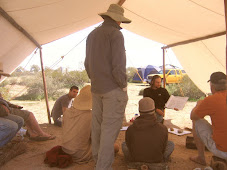
It was another great time at the Wintercount Primitive Skills Rendevous this year.  Beautiful weather and beautiful people; primitive skills galore and amazing speakers and discussions; and, as always, a wonderful sense of community in the Arizona desert.  Now that I'm back in freezing cold Utah, I'm kind of kicking myself for not getting more sun while down south.  Oh well, I guess I'll have to keep up my vitamin D stores through food.

My class on Primitive Nutrition and Health was a blast to teach.  The folks in attendance were very engaged and had lots of insight and knowledge to share.  I'm always amazed by the collective wisdom of a group of people, and the discussions that came about from this particular group were quite thought-provoking, to say the least.  I'm especially grateful for the folks that were well-versed in some of the finer details of human evolution, which really added a lot to the class.  It was also fun hearing others' stories about diet and health and their response to some of the material I provided.  One man, who had been on a diet of donuts and soda, expressed his relief that to eat healthy doesn't mean that you have to munch on baby carrots and celery all day long -- and that a diet of steak and potatoes is a viable way to achieve wellness.  He liked that idea very much.

Tuesday, February 8, 2011

Wintercount Primitive Skills Rendezvous 2011


I'm off to Arizona for the yearly primitive skills gathering, Wintercount.  I'm looking forward to going "abo" for an entire week and teaching a few classes.  This year, I'll be covering the history of the human diet -- from paleolithic to modern -- and the studies of Weston A. Price once again, along with an edible Sonoran Desert plants walk.  I'm hoping to learn more about the atlatl, as well, as I want to set up a range at the wilderness rehab I work for.  Should be a good time.  If any of you blog readers out there are planning on being there, I'd love to meet you!

I'm also planning on picking up my Homeoblock on the way back, so I'll update everyone on the details on that upon my return.  See you in a week or so!
 

Monday, January 24, 2011

My Intestinal Saga, Part 4: Gurus and Rotten Meat

Rotting meat in mason jars.
So there I was.  It was late summer 2006.  The sweltering Tucson sun beat down on the city relentlessly.  White tail doves could be heard flapping and cooing on rooftops and power lines, and the cicadas' symphony was in full swing.  I sat inside, bathing in the cool air of the swamp cooler, a plate of raw ground beef sitting in front of me.  I took a bite.  It went down easy.  I took another and my body screamed for more and more -- so I fed it.  I followed the meat with a few spoonfuls of raw, "unheated," honey and some raw butter.  I was satisfied like I hadn't felt in years.  And it was all thanks to a man by the odd name of Aajonus Vonderplanitz and his book, The Recipe For Living Without Disease.  In this book, Vonderplanitz outlined the key to optimal health and vitality through food, and it enthralled me.  Raw meat, unheated honey, raw dairy, raw vegetable juices -- these were the ingredients to becoming well again, and I had no problem eating all I wanted and enjoying the heck out of it.  My family and friends were somewhat worried about me at his point.  Salmonella, E. Coli, and countless other bacteria existed in raw food products -- how would this negatively affect my health, particularly my already stressed out gut?  Surely I would get food poisoning at the very least.  And straight butter?  Heart attack city!  Well, after several weeks of the eating all of the foods suggested by the quirky Aajonus, I was happy to report that I had absolutely no problems.  In fact, I had more energy than I could remember feeling in my whole life.  Then I thought, "Hmm.  I wonder if I could feel even healthier?"

Aajonus Vonderplanitz believed if raw meat was healthy, then rotten or "high" meat is probably even healthier.  The Inuit traditionally enjoyed rotted flesh as part of their diet, and so did many cultures around the world.  I was insanely curious about this.  Would it feel good in my body?  Or would I get really sick?  So I began making "high" meat -- filling mason jars with sliced up beef and airing them out every few days.  Oddly enough, the rotten smell that developed over a few weeks began to please my senses.  It smelled good, it looked good -- I couldn't wait to eat it.  Then the day came when it was ready.  So I took a jar filled with rotting, slimy meat outside, opened it, and reached in for my first taste of this supposed health elixir.  I loved it.  Weird, I know.  It just tasted way good for some reason.  Although the little white beads on the meat that had developed over the weeks somewhat disturbed me.  Were these some kind of worm eggs or something?  Was I ingesting parasites?  Well, even if I was, Mr. Vonderplanitz assured me in his book that they would merely detox my body and consume my unneeded intestinal wastes.  Win-win for me and my little worm buddies.  They get to eat and I get better!  Oh lord, I have done some interesting things in my life, and this one is up there on the list.

Again, much to my surprise, the most shocking thing that happened was -- well, that nothing happened.  I remained healthy and feeling quite good overall on my raw and rotten diet.  After a few months of this "primal diet," I encountered something even more alluring in my continual research: the raw paleo diet.  I joined a forum where there were a handful of folks experimenting with this diet -- consisting of nothing but raw meat and fat -- and experiencing great results.  (Apparently these folks still exist.)  Their stance on eating mostly organ meats made a lot of sense to me, as this was where the most nutrients exist, and if my goal was optimal health, well then I wanted all the nutrients I could get, gosh darn it!  I began the raw paleo diet with enthusiasm, picking up raw liver and raw beef fat from the butcher at a local organic foods store.  Damn, did that stuff taste good to me.  I swear, at the time, the liver tasted like chocolate and the beef fat tasted like ice cream.  Soon I was gorging on kidneys, spleens, tongues, and any other raw offal I could get my grubby little hands on.

Pretty soon I realized that zero-carb, raw paleo was the way to go (naturally, right?).  I felt great -- well, for the most part.  My back pain was pretty much gone at this point, but I seemed to have developed hard stools from the sudden transition to zero carbs + zero fiber.  Not only that, but I began to see fat chunks in my stool, which, at first I thought were gall stones until, ahem, closer inspection.  There also was this "heavy" feeling in my body at times, like I was walking underwater.  Also, another problem --chest pain -- came about when I started to try to eat only one large meal a day, as some folks on the raw paleo forum were suggesting as the optimal eating pattern.  It would sort of come and go and actually wasn't too bad ... until I tried to do some push-ups -- ouch.  I thought I was having a heart attack.  I calmed myself and decided that maybe it was just some kind of strain.  It hurt horribly for two days.

The Bear
During my raw paleo stint, I was also floating around the Active Low-Carber forum and talking with some zero-carb folks on there.  (You can probably still look up my posts; just search for my username, "rk900.")  We were a ragtag bunch of wandering souls.  There were people who swore that the only thing that kept their weight stable was absolutely no carbs -- not even too many eggs or liver.  Others were on the paleo bandwagon.  Still others were curious about the diet, but were not bought in due to fears of losing their cherished carbohydrates.  I felt proud to be one of the few who was practicing full-on paleo zero-carb, just as primitive humans had done for millions of years before me (or so I thought).  Then, all of the sudden a post appeared: "The real human diet is a totally carnivorous one."  The author of the post was a man simply known as "The Bear."  It began:

I have been eating the natural human dietary regime for over 47 years now. I do not eat anything whatsoever from vegetable sources. The only things veggie I use are spices. My diet is usually 60% fat and 40% protein by calories. I used to eat 80/20 when younger and about twice as much quantity of meat also, but that seems too much energy at my age, which is 71- even though I am very active. I think the body actually becomes more efficient with energy as you age, but I have no way of proving it true. Otherwise, my body today is very like it was at the age of 30. I figure most of what we call 'aging' is due to insulin damage to the collagen and other body structures. No carbs = no insulin. I don't heal quite as fast when injured as I did as a youngster, however. But I have few wrinkles, and my skin is still strong and elastic.

The guru had arrived.  Responses came pouring in.  The Bear had answers for everything.  His healthy 47 years of experience with the zero-carb "regime" proved that modern humans could live well on such a diet without problems.  There was a very strong divide on the forum: some loved him and others thought he was full of crap.  One guy even started a dedicated blog on the "Zero Carb Path."  The Bear validated everything I believed at the time, and I followed guru's advice on eating and living well.  I still had the aforementioned problems with my gut, but decided that I felt better than any other time in my life, so I continued on "the path."


The saga continues in Part 5, coming soon.
  

Monday, January 10, 2011

Palate Expansion Update, 1/10/11: First Appointment

Brief break from "My Intestinal Saga" to bring all you readers out there an update on my palate expansion pursuits ...

I'm a few weeks away from being an official homie on the block.  I recently took a trip to Flagstaff, AZ for my first Homeoblock appointment.  The dentist, Scott Darlington, was very pleasant and shared his excitement about the procedure.  It's rare that people come to him for adult palate expansion, which he thinks is unfortunate because the benefits are so great -- particularly in opening up the airways.  I told him I was interested to see how my craniofacial structure would change and whether or not this procedure would provide any significant benefits for me.

For this initial appointment, I had a short dental check-up followed by my mouth being filled with plaster to make forms of my upper and lower palate -- all of which was completely painless.  These forms are currently being sent to a lab where they will be used to manufacture my own custom Homeblock.  This usually takes a few weeks.  I plan on returning to Dr. Darlington's office in Flagstaff to pick up my appliance around mid-February on my way to Wintercount.  For the first few months, Dr. Darlington recommends wearing the Homeoblock as much as I can, including daylight hours.  After this, I will only have to wear it at night and it will be recreated every few months to continue optimal expansion.  The cost for all of this -- appointments, new appliances, and all -- is $2000.  I payed up front for a substantial discount of $250, so the final cost was $1750.  I'm looking forward to looking like a retainer-wearing teenager for a short time -- maybe I'll even have a cool accent like Shelly from South Park.