Monday, March 1, 2010
Wintercount Rendezvous 2010
After going shirtless and stocking up my vitamin D reserves in the Sonoran Desert at the Wintercount Rendezvous, I'm back to blogging and am pretty excited to share some of the experiences I've had over the last few weeks. I bought a digital video camera just before attending the gathering in order to document some of my Primitive Nutrition classes, as well as an interview or two. Now I'm learning how to edit the footage and soon will have some of these videos to share here on my blog. For now, I thought I'd provide a glimpse into what I've been up to lately -- particularly for all you curious folks out there who might be asking yourselves, "Just what in the heck in this 'Wintercount' thing this guy mentions so often?" Enjoy!

Tuesday, January 19, 2010
Small Game in Primitive Living, Part 3: Cooking For Maximum Nutrients
Indigenous peoples all over the world applied universal cooking practices to their animal foods for optimum nutrition. For larger game, a common practice was to consume nutritious organ meats -- liver, kidneys, heart, etc. -- in addition to muscle flesh and fat after roasting over the fire, boiling in stews, or burying in pits lined with hot rocks. The full spectrum of amino acids, water-soluble and fat-soluble vitamins exist in these parts of the animal. For minerals, bones were added to long-cooked broths or cracked open to extract the rich, creamy marrow inside. Smaller bones were sometimes gnawed on; the flavorful juices perhaps provided a dose of calcium and gelatin, similar to the nutrients found in bone broths. The Townsend Newsletter For Doctors and Patients (2005) published an article about the properties of traditional bone broths and had this to say about nutritional content:
Broth can be thought of as a protein supplement, and a calcium supplement. The chemical ingredients extracted from broth are glycine and proline (collagen/gelatin), calcium and phosphorus (minerals), hyaluronic acid and chondroitin sulfate (GAGs), and other minerals, amino acids and GAGs in smaller amounts.
 If my memory serves me correctly, I once read an anthropological account of a few hundred years ago in which one Native American tribe always had a pot of broth on the fire and added scraps and bones to this pot continuously. The observer of this practice states that this tribe drank "copious" amounts of the broth.
Aside from the boiling of bones to release their minerals and nutritive elements, some tribes went to great lengths to supply yet another source of fat -- in addition to marrow and body fat deposits -- called "bone grease." This type of fat was attained by the long boiling of smashed bone and skimming the resultant grease off the surface. In a book called Imagining Head-Smashed-In: Aboriginal Buffalo Hunting on the Northern Plains, author Jack Brink goes into incredible detail about the production of bone grease, even going so far as to reproduce indigenous boiling techniques by adding hot, fire-heated rocks to buffalo hide containers filled with water. He explains how bone grease is different than marrow:
Though bone looks to be solid, it is really more of a latticework of twisted strands of bone tissue interspersed with tiny spaces ... The tiny spaces ... aren't empty; they are filled with small globules of fat. Called bone grease, it is a fat separate from the marrow in that is located in the bone structure itself, not the marrow cavity. (p. 190)
Another universal practice among primitive cultures is the use of blood. In a class I took at Wintercount one year, called "Using the Whole Animal," we caught the blood of a freshly slaughtered goat in a bucket and consumed the thick, scarlet red liquid after cooking it in a frying pan over a fire. It resembled ground meat and tasted very rich and satisfying. Of course, many of us know of the Masai and their practice of drinking raw, fresh blood -- so cooking isn't a requirement. Blood is a good source of electrolytes, especially sodium, which are sometimes hard to come by in primitive living. It is also high in protein and, in and of itself, a very sustaining food.
Powdered Woodrat
Now that we've reviewed some of the primitive cooking and eating practices for larger animals, let's examine how this information relates to the main subject of this series: small game. While it goes without saying that all of the nutrients present in large game are also present in smaller game, the difference in cooking techniques to maximize these nutrients requires some explanation. The cooking of small game is perhaps a simpler, more effective means of maximizing nutrition in primitive living due to the simple fact that long boiling times and extensive processing and butchering is not required. In fact, many small animals can be eaten whole, bones and all (of course, removing the intestines is a probably good idea in any case).
 Author Paul Campbell, who I've met at several primitive skills gatherings, documents the traditional hunt and preparation of white-throated woodrat in his book, Survival Skills of Native California
 (pp. 340-345). A Kiliwa Indian named Sam Ochurte leads Campbell on the hunt and, after procuring a few woodrats by way of bow and arrow, the native builds a small fire to cook his quarry. He then singes the hair off, cooks the skin to a crisp, bacon-like consistency and removes the charred pieces of skin, eating each with a pinch of salt. Ochurte then removes the intestines from the woodrats and returns them to the coals to finish cooking. When thoroughly cooked, the whole rats are set upon one rock and pounded with another, as in a mano and metate setup, until they are a small pile of shredded meat and crushed bone. He then picks out any uncrushed fragments and the rest -- smashed up bones, teeth, meat, and organs -- he eats. As Campbell acknowledges, "The nutritional value of even one complete rodent must have been considerable."
Campbell notes that similar processing techniques were observed historically in several other California tribes. Rabbits, hares, squirrels, and other small game were prepared this way. In addition to this, larger game bones, such as deer vertebrae, were also pounded and stored or eaten -- ancient calcium supplements in a sense. He describes other cooking methods for small game, including the boiling of whole small animals -- taken out temporarily to remove the skin similar to the above account -- and eaten whole, guts and all.
By using the whole animal, primitive peoples easily attained the nutrition required for optimal health, and modern abos would be wise to follow suit in primitive living excursions and experiments if they are to sustain their health and maximize nutrients to thrive in the wilderness.
Broth can be thought of as a protein supplement, and a calcium supplement. The chemical ingredients extracted from broth are glycine and proline (collagen/gelatin), calcium and phosphorus (minerals), hyaluronic acid and chondroitin sulfate (GAGs), and other minerals, amino acids and GAGs in smaller amounts.
If my memory serves me correctly, I once read an anthropological account of a few hundred years ago in which one Native American tribe always had a pot of broth on the fire and added scraps and bones to this pot continuously. The observer of this practice states that this tribe drank "copious" amounts of the broth. Aside from the boiling of bones to release their minerals and nutritive elements, some tribes went to great lengths to supply yet another source of fat -- in addition to marrow and body fat deposits -- called "bone grease." This type of fat was attained by the long boiling of smashed bone and skimming the resultant grease off the surface. In a book called Imagining Head-Smashed-In: Aboriginal Buffalo Hunting on the Northern Plains, author Jack Brink goes into incredible detail about the production of bone grease, even going so far as to reproduce indigenous boiling techniques by adding hot, fire-heated rocks to buffalo hide containers filled with water. He explains how bone grease is different than marrow:
Though bone looks to be solid, it is really more of a latticework of twisted strands of bone tissue interspersed with tiny spaces ... The tiny spaces ... aren't empty; they are filled with small globules of fat. Called bone grease, it is a fat separate from the marrow in that is located in the bone structure itself, not the marrow cavity. (p. 190)
Another universal practice among primitive cultures is the use of blood. In a class I took at Wintercount one year, called "Using the Whole Animal," we caught the blood of a freshly slaughtered goat in a bucket and consumed the thick, scarlet red liquid after cooking it in a frying pan over a fire. It resembled ground meat and tasted very rich and satisfying. Of course, many of us know of the Masai and their practice of drinking raw, fresh blood -- so cooking isn't a requirement. Blood is a good source of electrolytes, especially sodium, which are sometimes hard to come by in primitive living. It is also high in protein and, in and of itself, a very sustaining food.
Powdered Woodrat
Now that we've reviewed some of the primitive cooking and eating practices for larger animals, let's examine how this information relates to the main subject of this series: small game. While it goes without saying that all of the nutrients present in large game are also present in smaller game, the difference in cooking techniques to maximize these nutrients requires some explanation. The cooking of small game is perhaps a simpler, more effective means of maximizing nutrition in primitive living due to the simple fact that long boiling times and extensive processing and butchering is not required. In fact, many small animals can be eaten whole, bones and all (of course, removing the intestines is a probably good idea in any case).
Author Paul Campbell, who I've met at several primitive skills gatherings, documents the traditional hunt and preparation of white-throated woodrat in his book, Survival Skills of Native California (pp. 340-345). A Kiliwa Indian named Sam Ochurte leads Campbell on the hunt and, after procuring a few woodrats by way of bow and arrow, the native builds a small fire to cook his quarry. He then singes the hair off, cooks the skin to a crisp, bacon-like consistency and removes the charred pieces of skin, eating each with a pinch of salt. Ochurte then removes the intestines from the woodrats and returns them to the coals to finish cooking. When thoroughly cooked, the whole rats are set upon one rock and pounded with another, as in a mano and metate setup, until they are a small pile of shredded meat and crushed bone. He then picks out any uncrushed fragments and the rest -- smashed up bones, teeth, meat, and organs -- he eats. As Campbell acknowledges, "The nutritional value of even one complete rodent must have been considerable."Campbell notes that similar processing techniques were observed historically in several other California tribes. Rabbits, hares, squirrels, and other small game were prepared this way. In addition to this, larger game bones, such as deer vertebrae, were also pounded and stored or eaten -- ancient calcium supplements in a sense. He describes other cooking methods for small game, including the boiling of whole small animals -- taken out temporarily to remove the skin similar to the above account -- and eaten whole, guts and all.
By using the whole animal, primitive peoples easily attained the nutrition required for optimal health, and modern abos would be wise to follow suit in primitive living excursions and experiments if they are to sustain their health and maximize nutrients to thrive in the wilderness.
Wednesday, January 13, 2010
Small Game in Primitive Living, Part 2: Protein, Fat, & Calories
Without a doubt, the procuring of adequate food while in a primitive living situation is one of the most consuming (pun unintended) tasks that any modern abo-wannabe participates in. After several days in the backcountry with a group of fellow primitive living enthusiasts, food fantasies inevitably come up. "Oh, man, it'd be so great if we came across a pizza smothered in cheese, topped with pepperonis and meat. " Sometimes these food fantasies take on a spirit of their own and the resultant food combinations are often dishes that no normal, well-fed human being would enjoy (or even think of, really) in civilization. I once heard a guy say, "I had a dream last night that I was gorging on Church's Chicken topped with ice cream and chocolate syrup." Mmm ... fried chicken and Ben & Jerry's in one glorious conglomeration.
What does it take to keep a person satisfied in the wilderness when he or she is living on the land, solely utilizing what is in nature to fill his or her belly? Is it possible to live primitively, happily, with a full stomach while keeping the food fantasies at bay? First and foremost, it depends on the environment in which one is attempting to get fed. Many natural areas in the world are sorely lacking in many of the abundant plants and animals that used to flourish only a few hundred years ago. In the Sonoran Desert, for example -- my stomping grounds -- wild antelope, grazing on extensive, lush grasslands, used to be a common sight. Now, in most areas where the antelopes once roamed and the grass once grew, there remains scrubby, sad-looking mesquite trees, strangling the land and creating an impermeable barrier of interlaced thorny branches. Along with over-hunting and over-population, this is a direct effect of over-grazing cattle on lands where they never ranged historically.
 Human beings have left a profound mark upon the earth, and this leaves folks who want to recreate a primitive living experience with limited resources. What modern abos are left with is but a miniscule piece of nature's pie. "The old gray mare, she ain't what she used to be." And, unless we go to Alaska or other relatively unspoiled places, we cannot simply walk out into our backyards and find dinner. Or can we?
A question I've pondered often is whether or not human beings can live comfortably and successfully with what is available in these altered natural places -- can we work with the limited resources available? While the abundance of large game animals and wild plant foods in most places -- especially deserts -- has dwindled, perhaps there remains an underestimated, underutilized opportunity for sustenance in small game animals, whose populations have remained relatively stable over time. Can squirrels, rabbits, birds, mice, and other tiny creatures provide all that a person needs to live well in the wild or elsewhere?
Matt Graham's experience suggests that it is indeed possible to meet at least one person's caloric and nutritional needs on such fare. By setting traplines of two simple traps -- one being a spring snare and the other being a Paiute figure-four deadfall -- checking them every day, and cooking the caught animals (mostly squirrels and rabbits) for optimum calories and nutrition, Matt was able to provide for himself during his three months of full-on primitive living in the southern Utah desert. However, over those three months, he also ended up slowly losing body mass, indicating inadequate caloric intake over time. Just how many squirrels and rabbits was he eating day to day? If he had attained more, would he have felt more satisfied and maintained a better body composition? And what quantity of small game would that require? I hope to discuss some of these questions with Matt at Wintercount. Until then, I thought it would be interesting to speculate a little.
Using the data from a research paper (intended for the evaluation of predators' diets in zoos) called "Nutrient Composition of Whole Prey (Excluding Fish) Fed in Zoos" -- and a lot of help from Stephan at Whole Health Source -- I was able to make some calculations and come up with the protein, fat, and calorie content of a few small game animals per pound of whole carcass (note: some animals are eviscerated, meaning their hides and internal organs are discarded):

Here we see that, while a pound of each animal provides adequate protein, when it comes to fat and overall calories, any person would be feeling pretty darn hungry after a while on such a dietary regimen. Aside from that, there's also the reality of just how many successful traps one can set in a day and just how many animals such traps can provide. Let's say we want a minimum of about 1500 calories per day, give or take. That would require roughly:
**Similar in weight to Gambel's Quail of the Sonoran Desert
If we want to have enough calories to maintain body mass and even build muscle in primitive living, it would require twice those numbers. Realistically, no person is going to be able to procure the amount of mice it requires to sustain a person in this way. I certainly wouldn't be up for setting the number of traps that it would take, considering the fact that one whole mouse is only one bite and down the hatch! However, when we look at some of the larger animals, surviving comfortably in the wild becomes more than a pipe dream. Catch a few squirrels, maybe some mice and quail, and a rabbit or two per day and you have the makings of a successful primitive living experience! The question of fat, however, is inescapable, and may require the taking of some animals soley for the fatty parts, which would add on a few more squirrels or one more rabbit to account for this need (if we are to achieve an ideal 60/40 or, best, 80/20 ratio of protein to fat).
Of course, not all of the animal can be eaten in most cases (aside from the very tiny ones) so we are left with the question of just how much of each animal can, in fact, be digested and utilized for nutrients. In the next post, we'll discuss cooking small game in primitive living.
Note: I realize I'm leaving out the addition of plant foods to the primitive diet and their caloric contribution. Seasonal variation and environmental degradation, not to mention the extensive processing many wild edibles require, makes them a questionable food source for practicing abos in many parts of the world. If they're abundant, though, definitely eat 'em!
What does it take to keep a person satisfied in the wilderness when he or she is living on the land, solely utilizing what is in nature to fill his or her belly? Is it possible to live primitively, happily, with a full stomach while keeping the food fantasies at bay? First and foremost, it depends on the environment in which one is attempting to get fed. Many natural areas in the world are sorely lacking in many of the abundant plants and animals that used to flourish only a few hundred years ago. In the Sonoran Desert, for example -- my stomping grounds -- wild antelope, grazing on extensive, lush grasslands, used to be a common sight. Now, in most areas where the antelopes once roamed and the grass once grew, there remains scrubby, sad-looking mesquite trees, strangling the land and creating an impermeable barrier of interlaced thorny branches. Along with over-hunting and over-population, this is a direct effect of over-grazing cattle on lands where they never ranged historically.
 Human beings have left a profound mark upon the earth, and this leaves folks who want to recreate a primitive living experience with limited resources. What modern abos are left with is but a miniscule piece of nature's pie. "The old gray mare, she ain't what she used to be." And, unless we go to Alaska or other relatively unspoiled places, we cannot simply walk out into our backyards and find dinner. Or can we?
Matt Graham's experience suggests that it is indeed possible to meet at least one person's caloric and nutritional needs on such fare. By setting traplines of two simple traps -- one being a spring snare and the other being a Paiute figure-four deadfall -- checking them every day, and cooking the caught animals (mostly squirrels and rabbits) for optimum calories and nutrition, Matt was able to provide for himself during his three months of full-on primitive living in the southern Utah desert. However, over those three months, he also ended up slowly losing body mass, indicating inadequate caloric intake over time. Just how many squirrels and rabbits was he eating day to day? If he had attained more, would he have felt more satisfied and maintained a better body composition? And what quantity of small game would that require? I hope to discuss some of these questions with Matt at Wintercount. Until then, I thought it would be interesting to speculate a little.
Using the data from a research paper (intended for the evaluation of predators' diets in zoos) called "Nutrient Composition of Whole Prey (Excluding Fish) Fed in Zoos" -- and a lot of help from Stephan at Whole Health Source -- I was able to make some calculations and come up with the protein, fat, and calorie content of a few small game animals per pound of whole carcass (note: some animals are eviscerated, meaning their hides and internal organs are discarded):

Here we see that, while a pound of each animal provides adequate protein, when it comes to fat and overall calories, any person would be feeling pretty darn hungry after a while on such a dietary regimen. Aside from that, there's also the reality of just how many successful traps one can set in a day and just how many animals such traps can provide. Let's say we want a minimum of about 1500 calories per day, give or take. That would require roughly:
- 56 adult mice (avg. 20 grams each)
- 2 gray squirrels (avg. 1.1 lbs each)
- 1/3 of an eviscerated domestic rabbit (avg. 9 lbs each)*
- 1/2 of an eviscerated black-tailed jackrabbit (avg. 8 lbs. each)
- 6 Japanese quail (avg. 1/3 lb each)**
**Similar in weight to Gambel's Quail of the Sonoran Desert
If we want to have enough calories to maintain body mass and even build muscle in primitive living, it would require twice those numbers. Realistically, no person is going to be able to procure the amount of mice it requires to sustain a person in this way. I certainly wouldn't be up for setting the number of traps that it would take, considering the fact that one whole mouse is only one bite and down the hatch! However, when we look at some of the larger animals, surviving comfortably in the wild becomes more than a pipe dream. Catch a few squirrels, maybe some mice and quail, and a rabbit or two per day and you have the makings of a successful primitive living experience! The question of fat, however, is inescapable, and may require the taking of some animals soley for the fatty parts, which would add on a few more squirrels or one more rabbit to account for this need (if we are to achieve an ideal 60/40 or, best, 80/20 ratio of protein to fat).
Of course, not all of the animal can be eaten in most cases (aside from the very tiny ones) so we are left with the question of just how much of each animal can, in fact, be digested and utilized for nutrients. In the next post, we'll discuss cooking small game in primitive living.
Note: I realize I'm leaving out the addition of plant foods to the primitive diet and their caloric contribution. Seasonal variation and environmental degradation, not to mention the extensive processing many wild edibles require, makes them a questionable food source for practicing abos in many parts of the world. If they're abundant, though, definitely eat 'em!
Monday, January 11, 2010
Small Game in Primitive Living, Sidebar: Awareness
Our pre-neolithic ancestors were able to achieve the feat of thriving in the wild -- seemingly impossible in the eyes of modern folks -- without a hitch. Why they were able to do this is simple: they knew the patterns; they knew where the food was; and they knew the ingenious methods to put a roast on the spit. In short: they knew the land.
So, before we get into the specifics of attaining adequate food in the wild -- calories and nutrients -- let's first acknowledge a very important primitive living skill that any modern-day abo should have in his or her repertoire: awareness. This means awareness of, not only skills, but also the place where these skills are being practiced. It goes without saying that knowledge of plants, animals, and seasonal variations in any given environment is a huge advantage in primitive living. Where's the water? Where's the food? Where's the hazards? Knowing these things is important. In addition to these things, an abo would be wise to have a keen sense of personal needs. This means asking questions, such as: What does true hunger feel like? When am I strongest? When am I weakest? Am I thirsty? Am I tired? It sounds easy enough, but, in my experience, this self-awareness was sorely lacking until I had plenty of "dirt-time."

To sum it up, awareness in primitive living can be thought of as a sense of one's own needs and how to meet them with the resources available. When we observe indigenous people in their environment -- their element -- it's readily apparent that they are very comfortable and content. They know themselves. They know their place. They are satisfied. With practice, we moderns can achieve a similar comfort and satisfaction in primitive living. In the world of health and nutrition, we cannot go back to the vibrancy in physical being of our ancestors. Similarly, in primitive living, we'll never be as skilled as Ishi, Last of the Yahi , but we can come close. I've met many people who have attained awareness, skills, and, most telling of all, comfort in the wilds. It can be done.
, but we can come close. I've met many people who have attained awareness, skills, and, most telling of all, comfort in the wilds. It can be done.For a great resource on increasing your own personal awareness and nature skills, I highly recommend the Kamana Naturalist Training Program created by Wilderness Awareness School. For absolutely amazing dirt-time experience, check out the Boulder Outdoor Survival School. Also, primitive living skills can be learned hands-on at an affordable price at any of a number of skills gatherings across the country, the big two being Wintercount and Rabbitstick. By combining awareness and skills, primitive living enthusiasts can become "whole" in nature and truly feel at home.
Small Game in Primitive Living, Part 2 -- in which I'll delve into the calories and nutrients of whole animals and cooking methods to get the most out of your small game quarry -- is coming soon ...
Saturday, January 2, 2010
Video Footage of Weston A. Price
I'm currently working on crunching some numbers to put together part two of the "Small Game in Primitive Living" series and will hopefully finish it soon. Until then, I thought I'd post this video I came across on YouTube the other day. It's a segment from an odd, somewhat dated television show -- public access, I'm guessing -- called "Homekeepers." The host is interviewing a woman -- a "Certified Nutritional Consultant" -- who describes the findings of Weston Price. I'm not sure who this woman is or what she's all about (besides the fact that she's very politically correct when it comes to nutrition) but I'm very grateful that she dug up some fascinating video footage of Price. If you want to skip the interview (which I would recommend) and go straight to the press release footage of Price, fast-forward to 3:26.
Friday, December 11, 2009
Small Game in Primitive Living, Part 1: The Paiute Deadfall
Some of you may recall the post I wrote on Matt Graham, called "Talking Nutrition with a Wild Man," in which I describe his 6-month primitive living experience and explain how he attained adequate nutritional support in the wilderness of southern Utah. Most of what he ate consisted of small game: mice, squirrels, rabbits. What I didn't get into was the methods Matt utilized to capture these animals and the specific nutrients and calories that they supplied him with. In this post I'll describe one of the methods he used -- my friend and yours, the figure-four Paiute deadfall. In a later post, we'll dive deeper into the nutrional contents and caloric contribution of small game commonly caught by such a trap.
 Yup, that's it. A few sticks and some cordage with a "toggle" piece attached. The sticks, made from pine, can be fashioned out of any sturdy type of wood. The uppermost stick in the photo -- the top-piece -- has cordage tied on and a notch carved into it for reasons you'll understand in a little bit. The other stick -- the foundation piece -- is carved to a flat point to fit nicely into the top-piece's notch; it's two stubby "legs" give it more stability when setting the trap. The cordage is made from artificial sinew, but any strong natural fibers will do. When I lived in the Sonoran desert, I was a big fan of yucca and agave fibers. I'll leave natural cordage-making skills for another time, though.

 You'll notice that, to complete the trap, I had to (1) find a rock with a nice flat bottom and wide base and (2) attain a long, thin bait stick to thread underneath the rock. Obviously, if I was actually setting this trap to procure an animal, I'd have speared some bait onto the bait stick before setting, such as local wild plants that a small animal might like -- maybe pinyon pine nuts, seed heads of various grasses -- or food I might have with me as trail snacks, such as raisins or peanut butter. Mice seem to really love raisins. Although no rodents came along after I set it, to my good fortune (and perhaps to the benefit of the more squeamish readers of this blog), this particular trap attracted a wild desert tangerine!
 Notice the rocks I stacked on top of the main rock after setting the trap. This increases the weight and, thus, crushing force and speed of the deadfall. It also allows me to evaluate the stability of the trap. Now let's trigger the trap, lift the rock, and see what happens to the unsuspecting tangerine:
 Ouch! As you can see, when the bait stick is tugged at or nudged in any way, the trap is triggered and the rock falls abrubtly, leaving very little time for the animal (or, in this case, fruit) to escape. The main components of the Paiute deadfall spring neatly into the air and out of the way of the rock, allowing the rock to lay perfectly flesh with the ground (or, ideally, a hard, flat rock underneath) -- only the thin bait stick, along with the bait, actually receives the impact. The unlucky creature who happened to trigger the trap is instantly crushed to death. Squish! Mouse pancakes!
Mouse Pancakes and Squirrel Flapjacks
When I was 19-years-old, I learned how to make my first trap from my long-time mentor and friend, Vince Pinto (who now owns and operates Raven's Way Wild Journeys). It was a simple little contraption. Two sticks, each around six inches long and some agave fiber cordage made for the basis of a trap that I would use to procure many rodents in many primitive living trips in the years that followed. Named the figure-four Paiute deadfall after the very crafty, very omnivorious Northern Paiute natives who apparently pioneered it, this ingenious trap is hailed by modern-day abos everywhere as a reliable way to provide food in the bush. Matt Graham certainly endorses it. In fact, on his primitive trip, Matt only used two traps to supply his meat quarry: the Paiute deadfall and a spring snare. Knowing how to set a few traps really well, in his opinion, is better than knowing how to set many types of traps poorly. Quality not quantity.
Taking into consideration all the Paiute deadfalls I've set over the years, I'd say that this trap has squashed a mouse or a squirrel 50% of the time. Set six traps, get three little critters in my stomach. Matt and other masters of this trap with plenty of "dirt time" in the wilderness probably have a much higher success rate due to intimate knowledge of their regions as well as years of refinement and experimentation.
The Paiute deadfall components, in all its glory (aside from the rock needed to set it), is pictured below:
Yup, that's it. A few sticks and some cordage with a "toggle" piece attached. The sticks, made from pine, can be fashioned out of any sturdy type of wood. The uppermost stick in the photo -- the top-piece -- has cordage tied on and a notch carved into it for reasons you'll understand in a little bit. The other stick -- the foundation piece -- is carved to a flat point to fit nicely into the top-piece's notch; it's two stubby "legs" give it more stability when setting the trap. The cordage is made from artificial sinew, but any strong natural fibers will do. When I lived in the Sonoran desert, I was a big fan of yucca and agave fibers. I'll leave natural cordage-making skills for another time, though.The dimensions pictured are by no means the only way to go about making this trap, but they seem to work well for me. All of the fancy carvings on the sticks aren't really neccesary, but I find them helpful in allowing me to adjust the length of cord on-the-fly by wrapping it around the top-piece, as well as securing the cord better on the bottom foundation piece. Below is what the trap looks like once it's set (here, you can see more clearly how I used the carvings):
You'll notice that, to complete the trap, I had to (1) find a rock with a nice flat bottom and wide base and (2) attain a long, thin bait stick to thread underneath the rock. Obviously, if I was actually setting this trap to procure an animal, I'd have speared some bait onto the bait stick before setting, such as local wild plants that a small animal might like -- maybe pinyon pine nuts, seed heads of various grasses -- or food I might have with me as trail snacks, such as raisins or peanut butter. Mice seem to really love raisins. Although no rodents came along after I set it, to my good fortune (and perhaps to the benefit of the more squeamish readers of this blog), this particular trap attracted a wild desert tangerine!Notice the rocks I stacked on top of the main rock after setting the trap. This increases the weight and, thus, crushing force and speed of the deadfall. It also allows me to evaluate the stability of the trap. Now let's trigger the trap, lift the rock, and see what happens to the unsuspecting tangerine:Ouch! As you can see, when the bait stick is tugged at or nudged in any way, the trap is triggered and the rock falls abrubtly, leaving very little time for the animal (or, in this case, fruit) to escape. The main components of the Paiute deadfall spring neatly into the air and out of the way of the rock, allowing the rock to lay perfectly flesh with the ground (or, ideally, a hard, flat rock underneath) -- only the thin bait stick, along with the bait, actually receives the impact. The unlucky creature who happened to trigger the trap is instantly crushed to death. Squish! Mouse pancakes!More Resources For the Paiute Deadfall
For brevity's sake, I'm going to leave a more detailed discussion of this trap to Jim Riggs, one of the great influences of the primitive skills movement and a man with a lot of "dirt time." His article "Rocking On with the Paiute Deadfall" is by far the most thorough and well-written piece I have seen on this subject. Those of you out there in cyberland who want to experiment with a Paiute deadfall will benefit greatly from Mr. Riggs' description of the trap.
Also, a very good explanation of the Paiute deadfall is given in this video. I've never met the man who made this tutorial (Mark Lummio of Bushcraft Northwest), but he seems to really know what he's talking about. Absolutely fantastic video.
In the next post, I'll get into the nutritional and caloric details of small game animals that a person might find underneath his or her deadfall rocks day to day; and I'll evaluate the realities inherent in living off of such fare as Matt Graham did: processing, cooking, and eating trapped animals to thrive -- not just survive -- in the wilderness primitively.
Thanks to my good pal, Jeff Macdonald, for helping with the pictures.
Monday, November 16, 2009
Roadkill Mule Deer: $417
Out here in rural Utah there really isn't much traffic. More than five cars driving through town at the same time feels like rush hour and fender-benders are rare. There isn't a stop light for at least 50 miles. Yet, safe as this sounds for drivers on these country roads, there are still dangers lurking behind every juniper tree, potential disasters waiting in the sagebrush. Deer, elk -- even rabbits -- are hazardous highway threats and can leap out into the road at any mile marker. The damage they can cause to a vehicle -- and the person inside that vehicle -- can be monumental. Anything from a smashed grill, broken headlights, or a complete totaling are all possibilities, along with injuries to driver and passengers if the deer or elk happens to blast through the windshield.

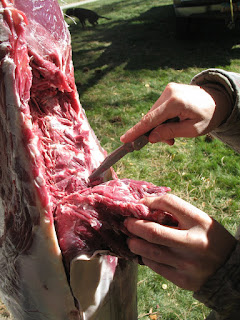 Roadkill Mule Deer: $417. A true country delicacy.
So I was glad to receive a phone call and hear that my friends, Danny and Gretchen, were safe and sound after hitting and killing a two-point mule deer buck near the town cemetery. I was also quite excited to hear that they intended to call the game warden and take th e deer home with them to butcher -- and that they needed my help to load the animal into their pick-up truck. "We'll give you some of the meat, if you're interested," Gretchen said. Hmm. Fresh venison, bones for soup, maybe some liver -- sounds good to me!
 e deer home with them to butcher -- and that they needed my help to load the animal into their pick-up truck. "We'll give you some of the meat, if you're interested," Gretchen said. Hmm. Fresh venison, bones for soup, maybe some liver -- sounds good to me!
 So off I went with my girlfriend at 9:30 p.m. to do a little "gathering." I can't really say that there was any hunting involved, as all we did was pick up a very dead deer. After loading it into Gretchen and Danny's truck, we agreed to meet up the next day to butcher.
On a beautiful Sunday afternoon in the front yard of a friends house, we began the fascinating process that human beings have engaged in for hundreds of thousands of years before us -- except we used modern technology to get the job done quicker. Danny tied one end of a rope to the hitch of his pick-up truck and the other end over a sturdy tree branch and around the buck's neck, almost like a noose readied for a hanging. Hopping in his truck and pulling forward, the 200+ lbs. animal magically rose into the air and was suspended at the perfect butchering height. Now that's country.

Danny then quickly and efficiently removed the hide of the deer by pulling it back and cutting the fine, sheath-like material just underneath. Once it was freed, Gretchen decided to work the hide and prepare it for tanning. Next, Danny hacksawed off the legs above the knee joints and began quartering the animal, procuring all the choice cuts: brisket, loins, backstrap, and plenty of meat for roasts. He had already thrown out the liver, heart, and other organ meats as they were all damaged and bloody. This particular buck was fairly lean, which makes sense given that it was a lower elevation-dwelling mule deer in October. Deer and elk in higher elevations would certainly be fatter this time of year as they pile on extra stores for the cold winter months.
Danny explained that much of the meat on the buck was questionable for human consumption due to the prevalence of CWD -- Chronic Wasting Disease -- in Utah deer populations. The risk of transmission of this prion disease (similar to the infamous "mad cow disease") to humans is thought to be very low, if at all. But we weren't willing to take the risk, so any meat stained with blood from the spine was discarded (CWD is a central nervous system disease). And we sure weren't about to eat deer brains either, so the head was also tossed.
In the end, after quartering and butchering the buck, we attained 70-80 lbs. of roasts, steaks, and tough meat for burger grind. My friend at the local meat locker was kind enough to blend the grind meat with some grass-fed beef fat he had on hand, which made for some amazing hamburgers. We also hacked up the bones, rich with marrow, for broth and soup.
Total processing costs: $17. Estimated damage to Danny and Gretchen's vehicle: $400.
Roadkill Mule Deer: $417. A true country delicacy.
Subscribe to:
Posts (Atom)

 Posts
Posts


